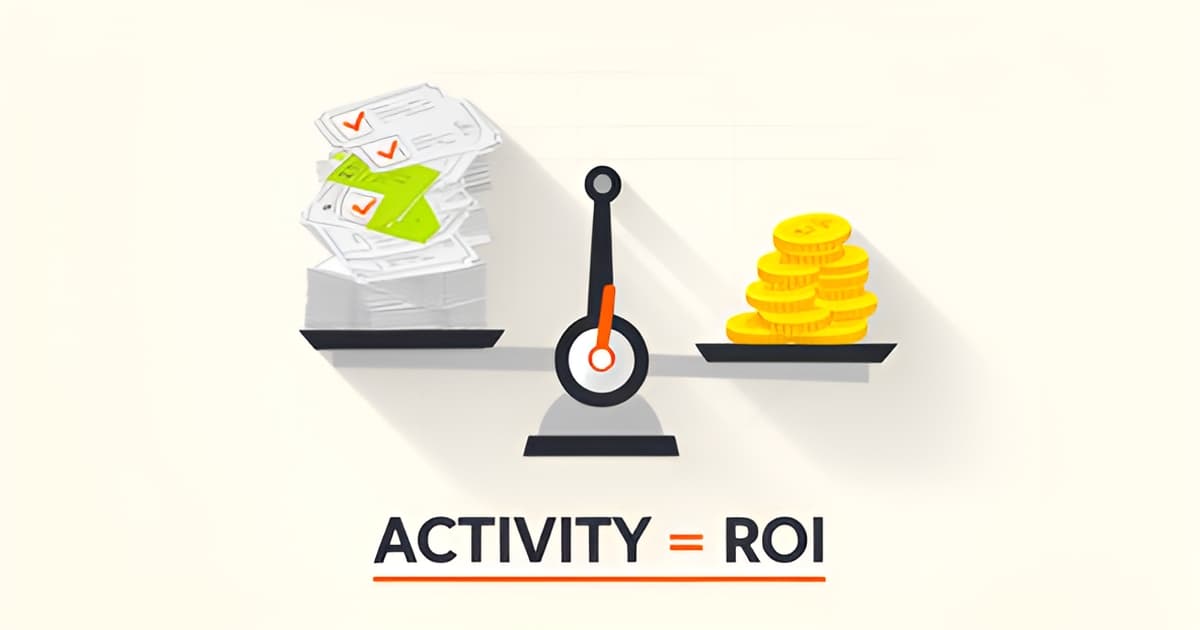
A press release crossed the wires this week promising "Six Essential Ways to Measure Event Performance," and while it's the kind of evergreen marketing content that shows up on syndication networks every month, it makes a point worth taking seriously: attendance counts don't prove an event worked. Registrations, headcounts, and cost-per-attendee figures explain activity. They don't establish return. If you run a marketing agency, an MSP, a staffing firm, or any B2B service that lives on new business, that distinction should sound familiar. It's the same trap that catches companies measuring outreach by raw send volume. A thousand contact form submissions means nothing if you can't say how many were confirmed, how many got replies, and how many of those replies were actually interested. The measurement discipline that smart event marketers have adopted over the past decade is exactly the discipline outreach programs need.
Key points
- Event measurement frameworks insist you define success metrics before the event, not after, and the same rule applies to outreach campaigns.
- Activity metrics (registrations, attendance, raw send volume) explain what happened but never prove financial return.
- Cost per attendee is a useful comparison tool, but it's not a standalone success measure; cost per interested reply is the outreach equivalent.
- Transparent reporting with consistent definitions (attempted vs. confirmed vs. failed) is what makes cross-campaign comparisons valid.
- Honest providers guarantee process quality, targeting, delivery attempts, and reporting, never reply outcomes, because no one can control another business's response.
The framework's most useful piece of advice isn't any single formula. It's the instruction to decide what success looks like before the campaign starts. Event teams that figure out their measurement criteria after the fact end up cherry-picking whatever number flatters them. You've seen this in your own industry: the webinar recap that leads with "over 500 registrations" and buries the fact that 120 people showed up. The same failure mode shows up in outreach. If you don't commit upfront to tracking confirmed deliveries separately from attempts, or interested replies separately from total replies, you'll be tempted to report the biggest number available. Decide your funnel stages in advance: businesses targeted, delivery attempts made, forms confirmed as received, replies generated, and replies classified as interested. Write them down. Then hold the campaign to them.
The event framework draws a clean line between performance indicators and financial return. Registration conversion rate (say, 150 registrations from 1,000 landing page visits, a 15% conversion) tells you whether your messaging and targeting worked. Attendance rate (350 of 500 confirmed registrants showing up, or 70%) tells you whether your reminders and timing worked. Neither number tells you whether the event generated revenue. Outreach has the same structure. A 90% form submission success rate is an activity metric. A reply rate is a better one. An interested-reply rate, the percentage of contacted businesses that actually raised a hand, is the metric that connects to money. When you evaluate any outreach partner, including a done-for-you service, ask which of these they report. If the pitch centers on volume ("we'll contact 15,000 businesses a month") without a word about confirmed delivery or reply routing, you're being sold an attendance count.
One of the event metrics, cost per attendee, comes with an honest caveat: it's useful for comparing formats and budgets, but a pricier event can still deliver more value per head. The number is a benchmark, not a verdict. The outreach equivalent is cost per interested reply, or cost per routed opportunity. Here's a concrete illustration. A pilot program costing $497 to reach 1,500 unique businesses works out to roughly $0.33 per business contacted. That's the activity cost. If the campaign produces 30 interested replies, you've paid about $16.50 per interested business. Compare that against what you'd spend per qualified lead on paid ads, or the fully loaded cost of an SDR generating conversations manually, and you have a real basis for a budget decision. The point isn't that one channel always wins. It's that you can't compare channels at all unless each one reports outcomes in the same units. "Cost per attendee" and "cost per send" are not comparable units. "Cost per interested reply" and "cost per qualified lead" are close enough to have a conversation about.
The event framework keeps hammering one operational detail: consistent calculation scope. What counts as an attendee at a hybrid, multi-session event? What counts as a "relevant visitor" for registration conversion? If definitions shift between events, year-over-year comparison becomes fiction. Outreach has the same problem, and it's worse because the industry has spent years muddying the water. Does "delivered" mean the form accepted the submission, or that a human at the business confirmed receipt? Does "reply" include an auto-responder? Does "interested" mean anything a person typed back, or only replies where a real human expressed genuine buying intent? This is why transparent reporting matters more than impressive numbers. A report that separates attempted from confirmed from failed, and states why each failure happened (form rejected the submission, captcha blocked the agent, page was down), gives you something you can audit. A report that says "15,000 contacts made" gives you something you can only hope about.
The event framework's final caution, that registrations alone don't establish ROI, points at a broader truth about demand generation: you can control your process, but you can't control other people's decisions. No event organizer can guarantee attendance. No outreach provider can guarantee replies. What an honest provider can guarantee is everything upstream of the reply. Targeting quality: the businesses contacted actually match your niche and geography. Delivery: real attempts made through real channels, with failures documented. Identification: messages that honestly say who's sending and why, no impersonation. Compliance: opt-outs honored immediately. Reporting: numbers with consistent definitions you can check. When you're evaluating any lead generation partner, that's the list to hold them to. A guarantee of replies would be a red flag, because it would mean either fabricated engagement or a definition of "reply" stretched until it's meaningless.
Put the pieces together and the outreach funnel looks a lot like the event funnel the framework describes. Reach maps to businesses targeted. Registration maps to confirmed delivery. Attendance maps to replies. Engagement maps to interested replies. Pipeline maps to opportunities routed to your sales process. Cost layers across every stage. If you're running outreach in-house or evaluating a vendor, build your dashboard around those five conversion points rather than around volume. Watch the drop-off at each stage. A campaign with strong delivery but weak replies has a message problem. Strong replies but weak interested-rate has a targeting problem. The funnel doesn't just measure performance; it tells you where to fix it.
The event marketing world spent years learning the lesson that headcounts don't equal revenue, and the frameworks that emerged from that lesson are worth borrowing. B2B outreach is going through the same maturation now. The agencies, MSPs, and service firms that win at this won't be the ones with the biggest send volumes. They'll be the ones who defined their metrics before launch, demanded consistent definitions from every report, and judged their acquisition channels by cost per interested conversation. Attendance counts don't pay bills. Neither do send counts. Routed, interested replies do.