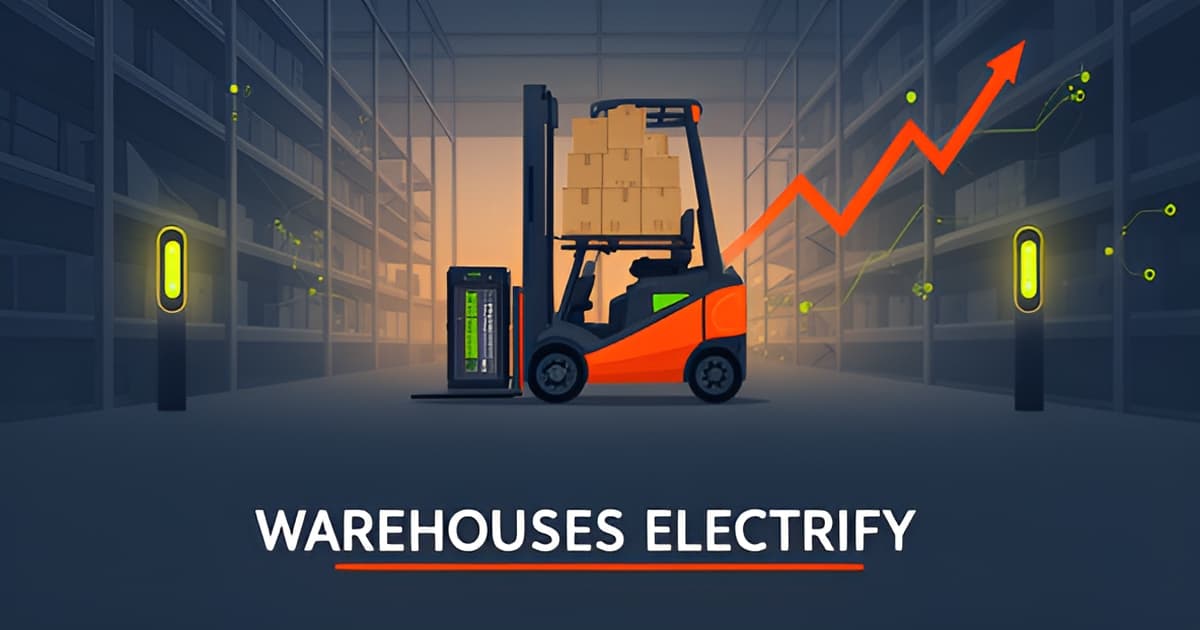
If you sell anything into the warehouse and logistics ecosystem, the numbers out of MarketsandMarkets this week should be on your radar. The research firm forecasts the global forklift market will grow from $101.70 billion in 2026 to $159.97 billion by 2033, a compound annual growth rate of 6.7%. That growth is being pulled along by two forces that have very little to do with forklifts themselves: the relentless expansion of e-commerce and the steady electrification of industrial equipment. The forecast, published October 23, 2026, lands at a moment when logistics operators are simultaneously dealing with labor shortages, rising costs, and pressure to decarbonize. Forklifts sit at the center of that convergence. They are the workhorses of every fulfillment center, distribution hub, and cold-storage facility, and the way they are powered, connected, and purchased is changing fast.
Key points
- Global forklift market valued at $101.70 billion in 2026, forecast to reach $159.97 billion by 2033 at a 6.7% CAGR.
- Class 3 electric forklifts are expected to hold over 52.2% of the 2026 market, with lithium-ion gaining ground in developed economies.
- E-commerce is the fastest-growing end-use segment, fueled by US online sales of $1.57–1.60 trillion in 2025 and European B2C e-commerce reaching EUR 842 billion in 2024.
- Asia Pacific leads both in size and growth rate; Europe is projected as the second-largest regional market.
- Battery price volatility, high automation costs, and tariff uncertainty remain key barriers for small and regional operators.
Three macro trends are doing most of the heavy lifting in this forecast. First, e-commerce continues to expand the physical footprint of warehousing. US online and non-store sales reached an estimated $1.57 to $1.60 trillion in 2025, according to the National Retail Federation, up 7 to 9% year over year. In Europe, B2C e-commerce hit EUR 842 billion in 2024, a 7% increase per EuroCommerce data. That growth is no longer confined to apparel and electronics. Grocery, cold chain, quick commerce, and B2B procurement are all pulling more square footage online, and every new fulfillment node needs material-handling equipment. Second, labor costs are climbing in nearly every major market, which pushes operators toward automation and equipment that requires fewer touches per unit moved. Warehouse automation spending is no longer a bet reserved for the largest 3PLs. Mid-market operators are adopting telematics, battery monitoring, and warehouse management system integrations as standard practice. Third, sustainability targets and total-cost-of-ownership math are pushing fleets from internal combustion to electric. The report projects that Class 3 electric forklifts alone will account for more than 52.2% of the 2026 market. That's a striking concentration in a single equipment class, and it reflects how dominant walkie-stackers and order pickers have become in modern distribution centers.
If electrification is the headline, battery chemistry is the subplot worth watching. Lithium-ion is gaining share in developed markets, particularly where operations run multiple shifts and opportunity charging can eliminate battery swap rooms. Less battery handling, fewer ventilation requirements, and lower maintenance overhead all favor the transition. Lead-acid isn't going away, especially in cost-sensitive applications and emerging markets, but the trajectory is clear. What's less clear is which lithium chemistry wins where. LFP (lithium iron phosphate) is favored in China and much of Asia, where supply chains are local and thermal stability matters in high-throughput facilities. NMC (nickel manganese cobalt) is more common in Europe and North America, where energy density and existing OEM partnerships shape buying decisions. Major manufacturers including Toyota, Jungheinrich, and Crown are diversifying their battery lineups to serve both camps. For anyone selling into this market, the regional split matters. A forklift dealer in Frankfurt has different stocking priorities than one in Shenzhen, and the vendors who recognize that will win more deals.
The forklift is becoming a connected device, whether operators planned for it or not. Telematics, remote diagnostics, regenerative braking, and operator assistance features are moving from premium options to baseline expectations. Fleet managers want to know battery state of charge, utilization rates, and maintenance intervals in real time. Integration with warehouse management systems is increasingly part of the procurement conversation. This shift creates a ripple effect across the vendor ecosystem. Software providers selling telematics dashboards, service companies offering predictive maintenance, and consultants helping operators right-size their fleets all benefit when the equipment itself is connected. The forklift is no longer just a piece of hardware; it's a data source.
Growth forecasts are useful, but the headwinds matter too. Battery price volatility remains a real concern. Lithium costs have swung dramatically over the past five years, and that volatility makes capital budgeting harder for smaller operators. High upfront automation costs put advanced systems out of reach for many regional players, even when the long-term economics favor adoption. And tariff and trade-policy uncertainty, particularly around Chinese equipment and battery imports, adds another layer of risk to fleet planning. These barriers don't change the direction of the market, but they do shape who buys what, and when. Vendors who can offer flexible financing, modular automation, or service-based pricing models will find more doors opening.
If you're running outbound campaigns targeting the material-handling, logistics, or industrial equipment ecosystem, this forecast gives you something most cold outreach lacks: a timely, relevant reason to reach out. The forklift and material-handling vertical is dense with reachable businesses. Forklift dealers, rental firms, warehouse automation consultants, telematics software providers, and industrial staffing agencies all operate at the intersection of these trends. Google Maps makes it straightforward to identify them by niche and geography, and a well-timed message that references e-commerce-driven warehouse expansion or the lithium-ion transition will land differently than a generic pitch. The data also clarifies which adjacent verticals are heating up. Managed service providers serving warehouse operators, staffing firms placing forklift-certified labor, and fractional executives advising mid-market 3PLs are all selling into a market that just got a public tailwind. For agencies and consultants, that's a signal to prioritize this niche before the rest of the outbound crowd catches on. One caveat worth noting: the MarketsandMarkets figure is a vendor-published projection, not audited market data. The same press release was syndicated across US, UK, and German outlets, and the full 354-page report sits behind a paywall. Treat the numbers as directional rather than definitive, and cite them honestly in your outreach. That kind of transparency tends to perform better than inflated claims, especially with operators who have been burned by overpromising vendors before.
The forklift market doesn't grab headlines the way consumer tech does, but it's a useful proxy for what's happening across the entire industrial economy. Warehousing is expanding, equipment is going electric, and connectivity is becoming standard. The companies that recognize these shifts early, whether they're selling forklifts, software, or services into the ecosystem, will have a meaningful advantage over the ones still pitching the same message they used in 2024. For B2B outreach teams, the takeaway is straightforward. A $100 billion-plus equipment market, growing at nearly 7% annually, with clear regional and technological sub-segments, is exactly the kind of vertical where targeted, data-informed campaigns outperform spray-and-pray. The research is public. The targeting is straightforward. What matters now is execution.